
- What generative engine optimization actually describes
- Where GEO-as-a-product goes wrong
- People-first content is the actual GEO lever
- Crawlability still decides if you exist
- Citations without invented authority
- GEO vs AEO vs 'rank in AI Overviews'
- A GEO pass that is just honest SEO
- What I tell founders who ask if they 'need GEO'
- FAQs
For Agency Owners · Intermediate · Informational · Solves: GEO retainers with no URLs, Acronym overlap with AEO, Pressure to ship AI files
Key takeaways
- GEO describes retrieval by generative systems. It is not a Google ranking factor you can buy.
- People-first, non-commodity content plus crawlability is the real work.
- Google says you can ignore special AI files, chunking, and extra schema for Search AI features.
- Keep GEO, AEO, and AI Overviews on separate URLs so they do not cannibalize.
Generative engine optimization is a useful label and a terrible product. The useful part is simple: generative systems retrieve pages, then quote what they can parse. The product part is a retainer that promises citations you cannot verify.
I am not going to sell you GEO as a new discipline with a secret file format. I am going to tell you what it collapses to once you ignore the pitch deck: people-first content, crawlability, and sources a human would trust.
That is distinct from the AEO strategy hub, which is about site architecture: one URL per question, hubs, and citation patterns. This page is about the GEO acronym itself, and why most of the market around it is a rename.
What generative engine optimization actually describes
People use GEO to mean 'show up when ChatGPT, Perplexity, Gemini, or Google's AI features answer a question.' Fair. The engines differ. The shared constraint does not: they need a page they can fetch, a claim they can check, and a reason to prefer you over a Wikipedia paragraph.
If your page is a paraphrase of the ten articles already ranking, you did not create GEO content. You created commodity content. Google's generative AI guidance uses that word on purpose. Unique point of view beats a summary of summaries.
GEO is not a ranking factor Google published. It is a sales name for work that already had a name: make pages worth retrieving.
The term spread because ChatGPT, Perplexity, and Google's AI features made 'we rank on page one' feel incomplete. Fair. Buyers now get answers that mix several sources. The mistake is treating that mix as a new ranking system you can buy a plugin for. Retrieval still starts with an index, a crawler, and a page that says something worth repeating.
I use GEO as a label in conversations so we are talking about the same fear. I do not use it as a line item that implies a secret implementation. If the statement still makes sense when you replace GEO with 'search,' it was SEO. If it only makes sense as a threat ('without GEO you will disappear'), it was a pitch.
Where GEO-as-a-product goes wrong
The product version usually includes some mix of: rewrite everything in Q&A chunks, ship an llms.txt, add mystery schema, and report 'AI mentions' from a dashboard you cannot audit. Some of that is harmless busywork. Some of it fights how Google says Search works.
- Chunking pages into tiny fragments because 'AI likes chunks.' Google says that is not required.
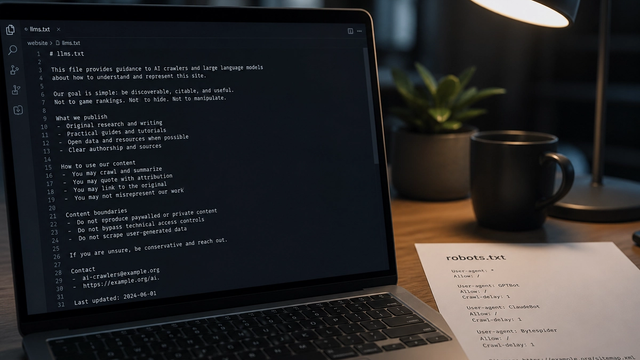
- A special machine-readable file as a Google ranking lever. Google Search says it does not use those files.
- A schema type that 'unlocks' AI Overviews. Google says no special schema is required for those features.
- Inauthentic mentions on sites that exist to sell mentions.
Read Google's guide to optimizing for generative AI features before you buy a GEO package. The mythbusting section is not subtle.
A useful GEO proposal names URLs, owners, and a measurement method you can reproduce in Search Console. A weak one names dashboards, mentions, and a file format. Ask what changes on the live HTML this month. If the answer is 'we submit you to our citation network,' you are in the inauthentic-mentions bucket Google already told you to ignore.
I also push back on rewriting the whole blog in a fake 'as a question, as an answer' cadence. Google's guide says you do not need to write in a special way for generative AI search. Models understand synonyms. Keyword-variant sprawl is how you get scaled content problems, not how you get cited.
People-first content is the actual GEO lever
Write for the person who has to make a decision. Say what you have seen on real sites. Name the failure mode. Give a sequence they can run this month. That is harder than spinning a listicle, which is why it still works.
If you use generative tools to draft, the published page still has to meet Search Essentials and spam policies. A model-written recap of other recaps is the opposite of what Google describes as non-commodity content. First-hand process, named constraints, and sources beat a fluent paragraph with no owner.
The people-first standard is still creating helpful, reliable, people-first content. GEO does not replace it. GEO marketing that ignores it is just a new wrapper on thin content.
Unique does not mean theatrical. For a product company it might be a teardown of your own onboarding, including what broke. For a consultant it might be the exact sequence you run before a migration. For a studio it might be the lock-in patterns you refuse to ship. If a competitor could publish the same page without changing a proper noun, it is commodity. Generative systems already have commodity. They do not need yours.
Images and video still help when they are real. A screenshot of the UI you are describing is useful. A stock photo of a robot handshake is not. Google's AI features guidance still lists supporting text with high-quality images and video. That is ordinary media SEO, not a GEO add-on.
Crawlability still decides if you exist
A generative system that grounds on the web can only ground on what it can retrieve. Blocked resources, empty HTML, duplicate hosts, and orphan URLs are still the boring killers. Calling the project GEO does not change robots.txt.
Make important content available as text. Support it with real images when images help. Keep internal links so a crawler can find the page without a sitemap miracle. That is classic technical SEO. It is also the floor for any 'AI search' conversation.
If JavaScript frameworks are in play, budget time for JavaScript SEO. Google can process JS when it is not blocked. Your other generative crawlers may not. The safe default for GEO is the same safe default for SEO: the claim lives in HTML. Anything else is a bet on a renderer you do not control.
For Google specifically, AI features and your website repeats the same eligibility: indexed, snippet-eligible, same technical requirements as Search. No extra GEO markup.
Citations without invented authority
If you want to be cited, be citable. State the fact. Link the primary source. Do not invent a percentage. Do not cite a roundup that cited another roundup.
Primary sources for this topic are Search Central, vendor docs, and your own public work. A screenshot of a dashboard with no methodology is not a source. Neither is 'industry studies show' with no study.
The AEO hub goes deeper on how B2B pages fail citations. The GEO version is shorter: if you would not put the number in a client report, do not put it on the blog.
Citation-ready also means you stop anonymizing every claim into 'experts say.' Name the document. Name the date. If the claim is your own observation, say it is your observation. Models mix sources. Your job is to be a source that does not require a cleanup pass.
Do not confuse a mention with a citation you earned. A directory that lists ten thousand agencies is not proof that a generative engine should trust you. Google's guide is explicit that chasing inauthentic mentions is weaker than it looks. Earn the mention by being the page that actually answers the question.
GEO vs AEO vs 'rank in AI Overviews'
The labels overlap. I keep them on separate URLs so they do not cannibalize.
- AEO strategy: architecture, one winning URL per question, hub and spoke.
- GEO: the generative-engine pitch, stripped down to content quality plus crawl plus sources.
- AI Overviews: Google-only, documented eligibility and measurement.
The tactical punch list is what to fix on your site first for AEO. The Google-specific version is how to rank in AI Overviews without chasing shortcuts. Do not clone this article onto those slugs.
A GEO pass that is just honest SEO
- Pick ten questions buyers actually ask. Map each to one URL.
- Add a unique point of view: a process, a constraint, a failure you have seen.
- Cite two primary sources on each winner.
- Confirm the page is crawlable as HTML and indexable.
- Measure in Search Console, including generative AI reporting when you have it, instead of a vanity mention tracker.
Ask for a before-and-after on specific URLs: title, H1, extractable answer, indexation, internal links. If the deliverable is a PDF of 'AI mention share' with no methodology, you cannot manage it and you cannot fire it. Work you cannot inspect is not a strategy. It is a subscription.
What I tell founders who ask if they 'need GEO'
You need pages worth retrieving. You need those pages findable. You need to stop publishing overlapping recaps. You do not need a new department named after an acronym Google already put in a mythbusting list.
If your site is a thin brochure, GEO will not save it. If your site already has proof, process, and technical hygiene, you are closer than the pitch suggests. Do the first-fixes work, then the architecture work. Skip the file format religion unless a specific crawler you care about documents that it uses it.
When a founder asks for a GEO roadmap, I give them a SEO roadmap with better answers and fewer twin URLs. Then I show them Google's mythbusting list so they can fire the part of the proposal that was theater. That conversation is shorter than a 40-page GEO strategy, and it ships.
If you want me to look at whether your GEO proposal is a rename of work you already bought, send the proposal and the site. I will mark what is real.
Implementation table
| Fix | Problem | What to change | Metric | Tool |
|---|---|---|---|---|
| One URL per GEO question | Overlapping recap posts | Pick a winner, redirect or demote twins | Fewer colliding titles | IA spreadsheet |
| Primary sources | Uncited claims | Link Search Central or vendor docs on each winner | Two sources on the page | CMS |
| Crawlable body | JS-only copy | Put the unique answer in HTML | Answer in raw HTML | view-source |
Someone sold you GEO. You still have overlapping recaps.
Send the proposal and the site. I will mark what is ordinary SEO, what Google already said to ignore, and which URL should win each question.
Book a GEO sanity checkSources & references