Business & FreelancingUpdated 8 min read

Answer Engine Optimization: What to Fix on Your Site First

The first 10 answer engine optimization fixes: titles, extractable answers, crawlable HTML, author identity, and internal links. Not a full AEO architecture plan.

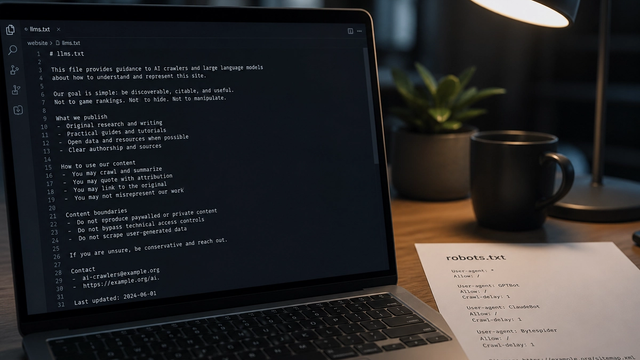
Checklist on a dark desk next to a laptop showing a website title tag and HTML outline

For Founders, Marketing leads, SEO specialists, Webflow and Next.js teams · Intermediate · Informational · Solves: AEO sold as a strategy workshop, Site not citation-ready, Unclear what to fix this week

Key takeaways

  • Fix retrieval hygiene on existing pages before you add an AEO content calendar.
  • Titles, a quoteable answer, and crawlable HTML matter more than a new acronym.
  • Author and organization identity should match the visible site.
  • FAQ text can stay; FAQ rich results in Google Search were retired in May 2026.

Answer engine optimization is usually sold as a strategy workshop. Most sites I see do not need a workshop first. They need ten unglamorous fixes on pages that already exist.

The architecture work still matters. One URL per question, hubs, citations, the whole information design. That is a different article. This one is the punch list I run before anyone opens a content calendar.

If you want the B2B architecture version, that lives in AEO strategy for B2B sites. Use this page when the site is already live and you need to know what to fix this week.

What first actually means

First means the work that unblocks retrieval. Models and search engines cannot quote a page they cannot fetch, cannot parse, or cannot tell apart from three sibling posts with the same title pattern.

I start on the money pages: services, the guides that already get clicks, and the about page. I do not start by renaming the blog category to AEO.

First also means you stop pretending a new article will rescue a page Google cannot index. If Search Console says crawled, currently not indexed on the URL you want cited, write a new post later. Fix that URL now. Answer engine optimization inherits that queue. It does not jump it.

I also ignore vanity tasks at this stage. A new glossary, a new 'AI visibility' landing page, and a new author that does not exist in the company: those are how teams avoid looking at titles and robots.txt. The first pass is rude on purpose. It names the pages that already have demand and asks whether those pages can be fetched and quoted.

If the HTML is empty, the title is clever, and the author is 'Admin,' you do not have an answer-engine problem. You have a site problem.

Fix 1 and 2: titles and extractable answers

Titles that name the job

A title should tell a human and a crawler what question the page settles. 'Insights' and 'Our approach' do not. Put the topic in the title tag and the H1. Make them close to each other. If the H1 is a slogan and the title is the real query, you trained two systems to disagree.

I rewrite titles on the pages that already rank or convert. I do not manufacture 40 new posts to 'cover AEO keywords.' Google's own guidance on generative AI features is explicit that more near-duplicate pages is a weak strategy and can trip scaled content rules.

An answer a person would actually quote

Put a short, direct answer near the top. Two to four sentences. Not a teaser. Not 'it depends' stretched across 400 words. If a sales call already has a one-sentence answer, that sentence belongs on the page.

This is answer engine optimization in the boring sense: make the answer extractable. Headings that ask the question help. A list of takeaways helps. A 90-word opening that never states the claim does not.

A usable title sounds like the query a buyer would type, without stuffing. 'Answer engine optimization: what to fix on your site first' tells you the job. 'Unlocking the future of discoverability' tells you the writer was scared of being specific. Keep the brand name out of the title unless the query is branded. Save the brand for the site name in the SERP.

The extractable answer should survive being lifted out of the page. If it only makes sense after three screens of story, it is not extractable. Lead with the claim, then explain. That is also how a good consultant talks. The blog should not be shyer than the call.

Fix 3 and 4: crawlable HTML and indexable URLs

If the important copy only appears after client-side JavaScript, you are betting that every crawler will render the page the way your laptop does. Google can process JavaScript when it is not blocked. That is not the same as 'ship an empty shell and hope.'

Follow Google's JavaScript SEO basics. View the raw HTML. Confirm the answer, the H1, and the internal links exist without waiting for a bundle. If they do not, fix the template before you write another article.

Then confirm the URL is allowed to be indexed. Accidental noindex, a robots Disallow on /blog, a canonical pointing at a thinner URL, or a staging host still public: those kill AEO the same way they kill SEO. There is no special AI workaround.

This shows up constantly on Webflow, Framer, and Next.js. Webflow can hide CMS items and leave them in an old sitemap. Framer can ship routing that looks fine in the canvas and thin in the HTML. Next.js can render the marketing copy only on the client if someone treated the page like an app shell. None of those are AEO-specific failures. They are why I look at the fetched HTML before I look at the copy deck.

If you use a CDN or bot fight mode, confirm Googlebot is not blocked while your laptop is allowed. Google's AI features doc lists crawling allowed in robots.txt and at the CDN as a best practice for a reason. I have seen 'AI visibility' projects stall on a WAF rule. The content was fine. The crawler was not.

Google's AI features documentation is blunt: to show up as a supporting link in AI Overviews or AI Mode, the page must be indexed and eligible for a snippet. No extra technical ritual.

Fix 5 and 6: author identity and organization identity

Who wrote this, and which company stands behind it? If the byline is missing, the about page is a mood board, and Organization markup names a different legal entity than the footer, you look like a content mill even when you are not.

For a personal brand or a small studio, a real Person page with a name, a photo, and a consistent URL is enough. Link it from every article. Put the same name in Article or BlogPosting markup. Do not invent a newsroom of ghost authors.

Google's Article structured data docs still matter for how Search understands headline, dates, and author. They are not a ticket into AI Overviews. They are how you stop looking anonymous.

Same for the company. One Organization name, one homepage URL, one logo file you actually use. If you rebranded last year and the schema still says the old LLC, fix that before you buy an 'entity SEO' slide deck.

The about page is part of this fix, not a brand afterthought. It should say who does the work, where the company is, and what you will not take. If every article byline links to a 404, you do not have author identity. You have a broken field in the CMS.

I do not spend the first week building a knowledge graph of 400 entities. I spend it making sure the Person and Organization that already exist are consistent in the footer, the byline, Article markup, and the social profiles you actually own. Consistency is the whole game at this stage.

Fix 7 and 8: internal links and unique H1s

Orphan pages do not get retrieved reliably. If a strong guide is only reachable from an old footer, put it back in the architecture. Link from the service page to the guide. Link from the guide back to the offer. Use anchor text that names the topic.

Then stop publishing two H1s that fight. If you have three posts that could all rank for 'answer engine optimization,' pick a winner and demote the rest to supporting URLs or redirects. That collision work is the core of the hub article. The first-week version is simpler: unique H1, unique title, one primary URL in the nav.

  • Every indexable money page should have at least one contextual internal link from a related page.
  • Related-link widgets that ignore the topic are decoration.
  • Do not point every leftover blog post at the homepage.

Fix 9 and 10: honest schema and FAQs as visible content

Keep Article or BlogPosting on articles. Keep BreadcrumbList if breadcrumbs render. Do not add FAQPage markup to chase a Google rich result. As of 7 May 2026, FAQ rich results no longer appear in Google Search. The questions on the page can still help a reader and a model. The dropdown in the SERP is gone.

Google's own AI optimization guide says structured data is not required for generative AI search and there is no special schema.org type you need to add for it. Use schema that matches visible text. That is the whole rule.

If you already have FAQs, show them as text. Write answers that a buyer would recognize from a sales call. Do not paste the same five generic questions on every service template.

The ten-fix sequence I actually use

  1. Rewrite the title and H1 on the top landing pages so they name the question.
  2. Add a two-to-four-sentence answer under the H1.
  3. Confirm that answer exists in the raw HTML.
  4. Confirm the URL is indexable: robots, canonical, no accidental noindex.
  5. Put a real author on the page and in Article markup.
  6. Align Organization name, URL, and footer.
  7. Add internal links from the commercial page to the guide and back.
  8. Kill or redirect duplicate H1s that answer the same question.
  9. Keep schema that matches the page. Drop FAQPage if you only added it for a rich result.
  10. Render FAQs as visible content where the questions are real.

That is a week of work on a small site, not a quarter. It will not replace a full technical pass.

On a larger site, do not run all ten fixes on every URL. Run them on the top landing pages by clicks and the commercial templates. Then copy the pattern into the CMS so the next blog post ships with a title, an answer, an author, and a link back to the offer. A one-off homepage edit that never reaches the article template is how this work dies in a week.

If the crawl is a mess, run the technical SEO audit checklist first. If you are choosing who should own that work, I wrote technical SEO consultant vs SEO agency for that decision.

What to skip this week

  • A new acronym on the homepage.
  • An llms.txt file as a ranking project. Google Search does not use special AI files for ranking.
  • Rewriting every paragraph into 'chunks' for models. Google has said that is not required.
  • Buying mentions on sites you would never send a client to.
  • Publishing a GEO clone of this article under a second slug.

The first ten fixes are unglamorous because retrieval is unglamorous. Titles, HTML, identity, links. If those are wrong, the strategy document is fiction.

Once those are in place, then do the architecture work: one winning URL per question, hubs, spokes, and citations. That is the other article. Doing it first is how teams write a beautiful IA while the live service page is still a slogan with a contact form.

If you want a second set of eyes on which ten pages to touch first, send the domain. I will mark the URLs, not the slogans.

Implementation table

FixProblemWhat to changeMetricTool
Quoteable openingNo extractable answerAdd 2-4 sentence answer under the H1 in HTMLAnswer visible in view-sourceCMS + view-source
Indexable URLBlocked or noindexed money pageFix robots, canonical, and noindexURL Inspection shows validSearch Console
Identity matchAnonymous or conflicting bylinesOne Person URL plus matching Article authorSame name on page and markupArticle schema docs

Your AEO plan started in a deck. The site still cannot be quoted.

Send the domain. I will mark the first ten pages to fix: titles, HTML, identity, and links. No acronym theater.

Book a first-fixes AEO call

Sources & references

Related links

Zlatko Marjanovic — founder of ZedNova Studios

Zlatko Marjanovic

Founder, ZedNova Studios

I am Zlatko Marjanovic, founder of ZedNova Studios and an AI product engineer. I take over Next.js, Supabase, and Stripe codebases, fix what is actually broken, and keep shipping.

On GitHub I work in public with Cursor, Claude Code, Next.js, and Supabase. On Upwork I help founders who already have a product, often one built fast with AI tools, and now need someone to stabilize auth, billing, and deploys.

I have been doing this for 7+ years and have shipped 120+ projects for US and EU teams. The work I care about is the layer after the demo: RLS, webhooks, Vercel, and the next version.

If you want help with a build, a messy repo, or a site that should rank and convert, email me at zlatkomarjanovic.zm@gmail.com.

LinkedInX / TwitterGitHubWebsiteUpwork
Older articleLanding Page Conversion Optimization: Fix the Offer Before the Button ColorNewer articleGenerative Engine Optimization Explained Without the Hype

Related