
For Agency Owners · Advanced · Informational · Solves: Overlapping articles, No citations, Chasing AEO acronyms
Key takeaways
- AEO inherits technical SEO. It does not replace it.
- One question, one winning URL.
- Cite primary sources. Do not invent stats.
- Schema must match visible content.
How to build an AEO strategy for a B2B company
One URL per question. Put the extractable answer in the first paragraph. Cite sources a model can check. Keep the commercial parent on technical SEO consulting. Do not publish another AEO URL for the same question.
An AEO strategy for B2B sites is not a new content calendar with 'write for ChatGPT' at the top. It is the same site architecture work good SEO always needed, plus a bias toward extractable answers, citations, and entities a model can attribute.
I am not going to tell you AEO replaced SEO. Google still sends commercial traffic. Answer engines still quote pages that are clear, structured, and boringly accurate. The hype is optional. The structure is not.
What AEO means in practice
Answer engine optimization is making your pages easy to retrieve, quote, and cite. That includes classic technical SEO plus on-page patterns: a direct answer near the top, headings that match questions, FAQs that are actually on the page, and schema that matches visible content.
This sits next to, not instead of, crawlable HTML and unique URLs. If the site cannot be indexed, no model will cite it reliably. See Google's search documentation first.
Start with structure, not with a tool
- One URL per job-to-be-done. Stop publishing six overlapping thought-leadership posts that answer the same question.
- A short answer block that a human would actually quote.
- Headings that name the question, not 'Our approach.'
- Sources you are willing to show.
- Author and organization identity that is consistent across the site.
Citations and why B2B pages fail them
Models prefer pages that state a fact, show who said it, and do not bury it under brand poetry. B2B sites fail this when every paragraph starts with the company name and never names a standard, a doc, or a dataset.
Cite primary sources: vendor docs, Search Central, standards, your own public case study. Do not cite a random listicle to look busy. Do not invent statistics.
Content architecture that helps retrieval
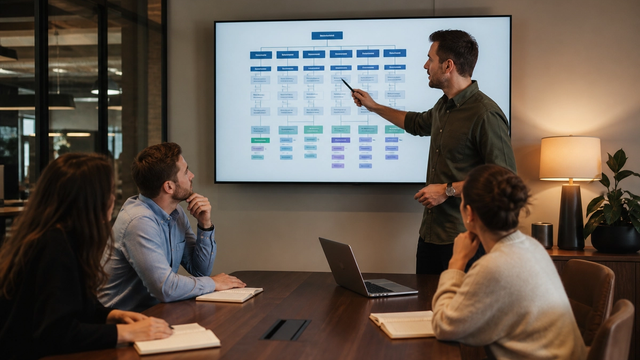
Build hubs. A service page should point to the deep guides that support it. Those guides should point back. Related links should be real URLs, not a tag soup. This is ordinary information architecture. It also happens to be how retrieval systems find a canonical explanation.
- Hub: the commercial page (service, product, industry).
- Spokes: the explanatory pieces that answer the questions sales already hears.
- A glossary or definitions only if you will maintain them.
On-page patterns I actually implement
- Quick answer near the top.
- Key takeaways as a list.
- FAQ that matches People Also Ask only when the question is real for the buyer.
- Article, FAQ, and Breadcrumb schema that match the visible page.
- An updated date when the advice changed, not when you touched a typo.
Schema types should follow schema.org and Google's structured data policies. Fake FAQ schema on pages with no FAQs is a shortcut that expires.
What not to do
- Do not stuff 'as an AI language model' patterns into human pages.
- Do not publish 30 nearly identical AEO / GEO / AI Overview posts. That is cannibalization with extra acronyms.
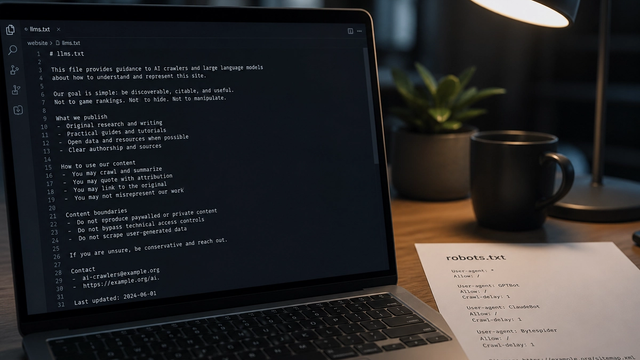
- Do not treat llms.txt as a ranking switch. It is an optional machine-readable hint.
- Do not buy 'AI citation' retainers that cannot show the URLs they improved.
If two of your own articles fight over the same question, you trained the model to shrug.
How this connects to the rest of the site
Machine-legible structure is the agentic layer I wrote about in where the web is going. The experience layer still has to convert. AEO without a booking path is a citation nobody pays for.
A 30-day AEO pass for a B2B marketing site
- List the ten questions sales hears every week.
- Map each to one URL. Merge or redirect the rest.
- Add a short answer and two sources to each winner.
- Fix titles, H1s, and internal links between hub and spokes.
- Validate schema. Remove types that do not match the page.
That pass will do more than a new acronym on the homepage. If you want help picking the winning URL for each question, send the current IA. I will mark the collisions.
Architecture is the long game. If you need the punch list before you rebuild hubs, start with the first AEO fixes on pages you already have.
Implementation table
| Fix | Problem | What to change | Metric | Tool |
|---|---|---|---|---|
| Question map | Overlapping posts | One winner per question | Duplicate topics reduced | IA spreadsheet |
| Answer block | No extractable summary | Add short answer + takeaways | Quoted snippet readiness | CMS fields |
| Schema match | Invisible FAQ schema | Render FAQs or remove type | Rich Results valid | Rich Results Test |
Your articles are fighting each other in AI answers.
Send the current topic list. I will mark the collisions and the one URL that should win each question.
Book an AEO architecture callSources & references